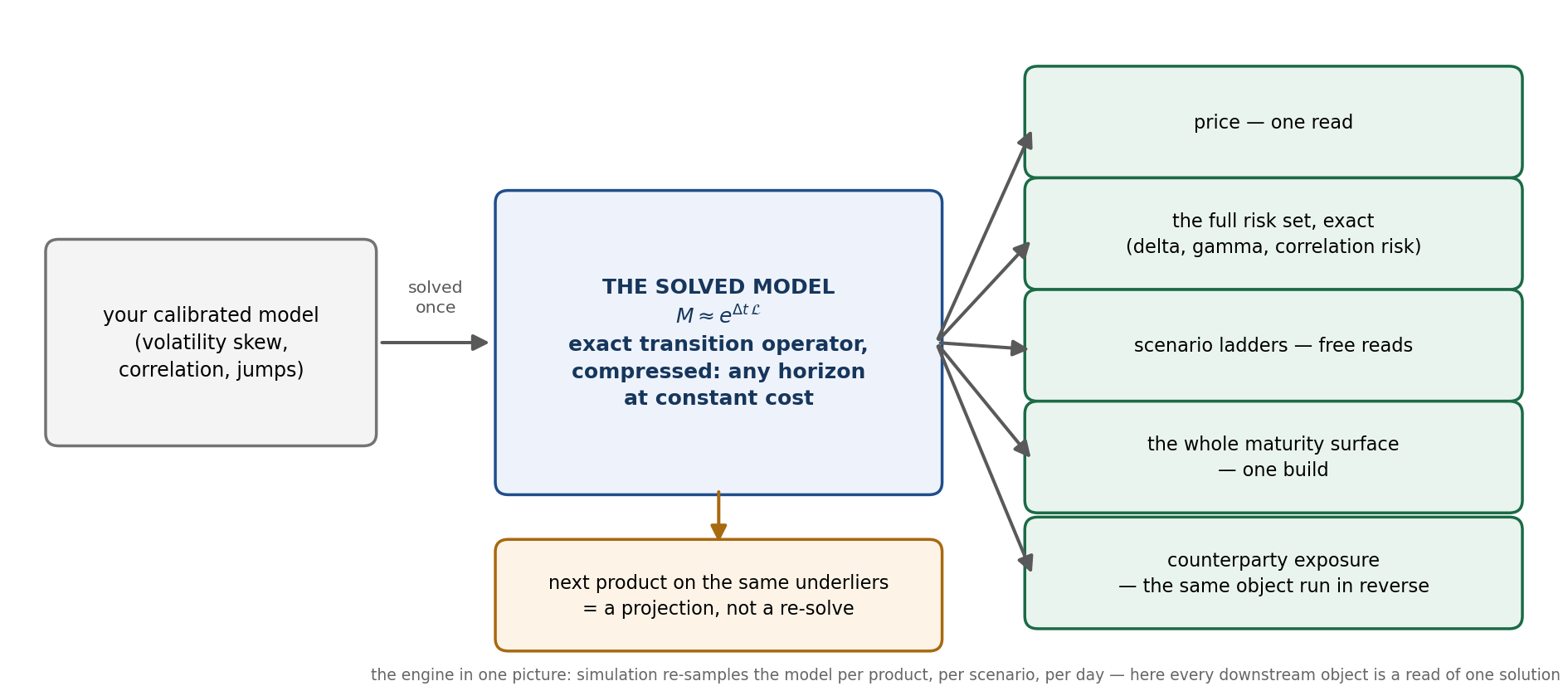
Krylo computes the model’s transition operator — the exact solution operator of the pricing equation — directly and to high order, once per underlier set. Every product, Greek, scenario, maturity, and counterparty-exposure profile after that is a cheap, noise-free read of one solved object.
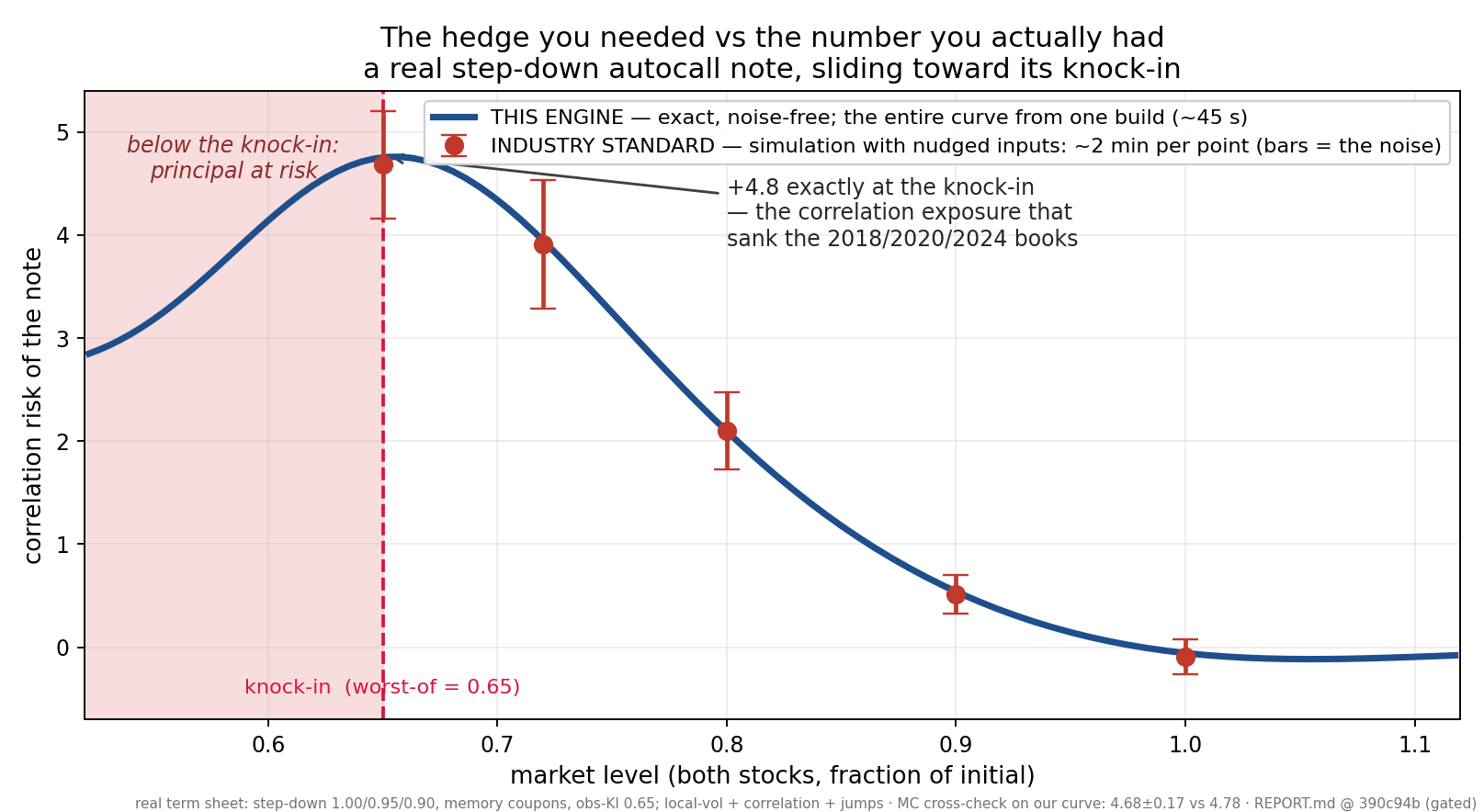
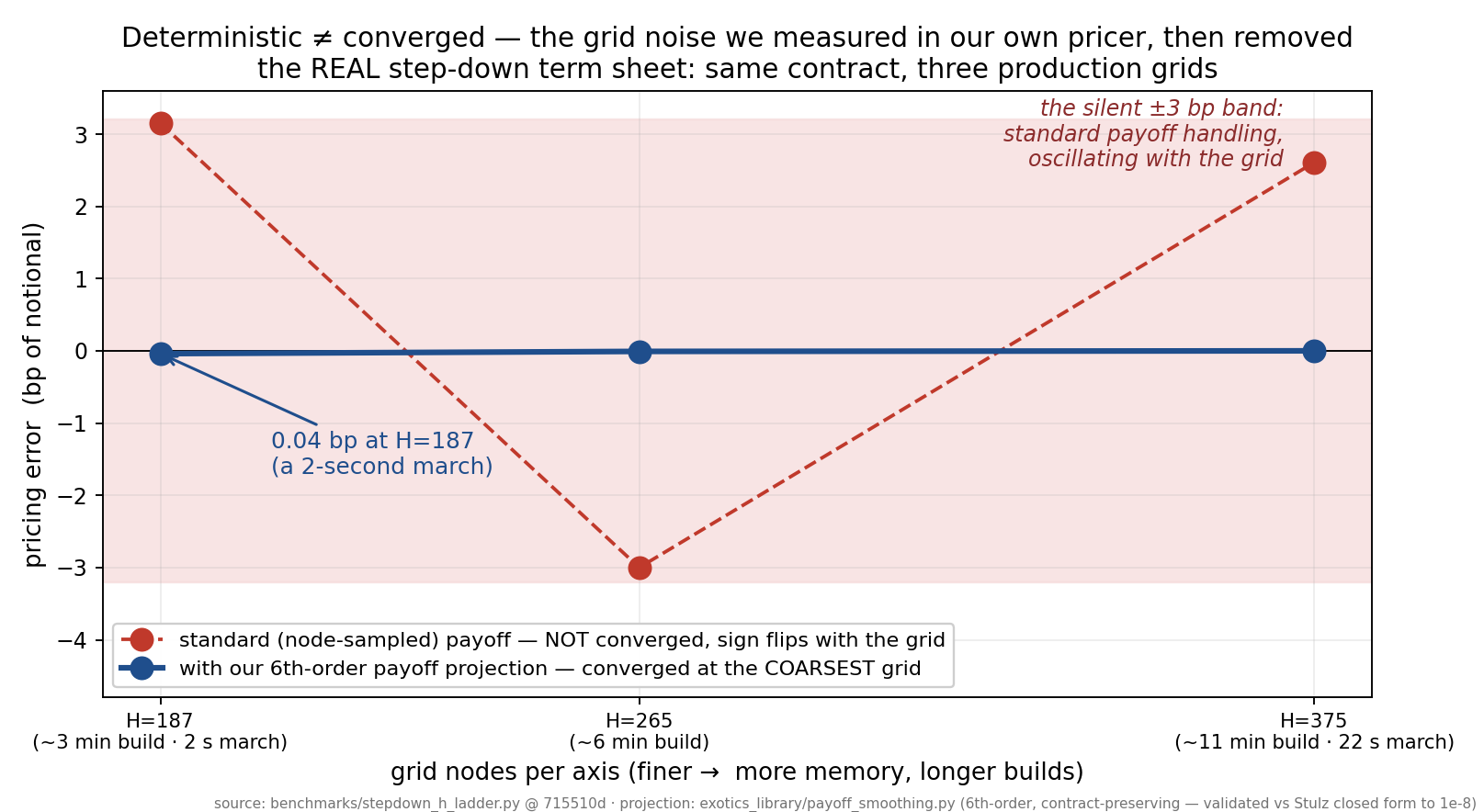
Worst-of and knock-in books broke their holders three times in six years — and the failure point is the same every cycle. The industry risk-manages these products by re-simulating them, and simulation-based risk numbers are at their noisiest exactly at the loss events: second differences across a payoff discontinuity amplify Monte-Carlo noise catastrophically. On a representative book of eight step-down notes, the industry-standard estimate of correlation risk came out at −0.06 ± 0.06 — the sign is unreadable on half the book, on the day it matters most.
One command rebuilds the full evidence base — provenance-stamped, with a numeric pass gate computed inside every benchmark. A regression flips the report on its own.
Monte-Carlo samples the transition operator one random path at a time. Finite differences re-step through it per product and per scenario. Neither ever constructs the reusable object itself. Krylo does — three components matter.
The short-time transition kernel is evaluated in closed form and moment-corrected to sixth order in space — with the correlation cross-term handled exactly, the term that forces operator-splitting compromises in ADI schemes. A one-year horizon is a handful of large, high-order steps.
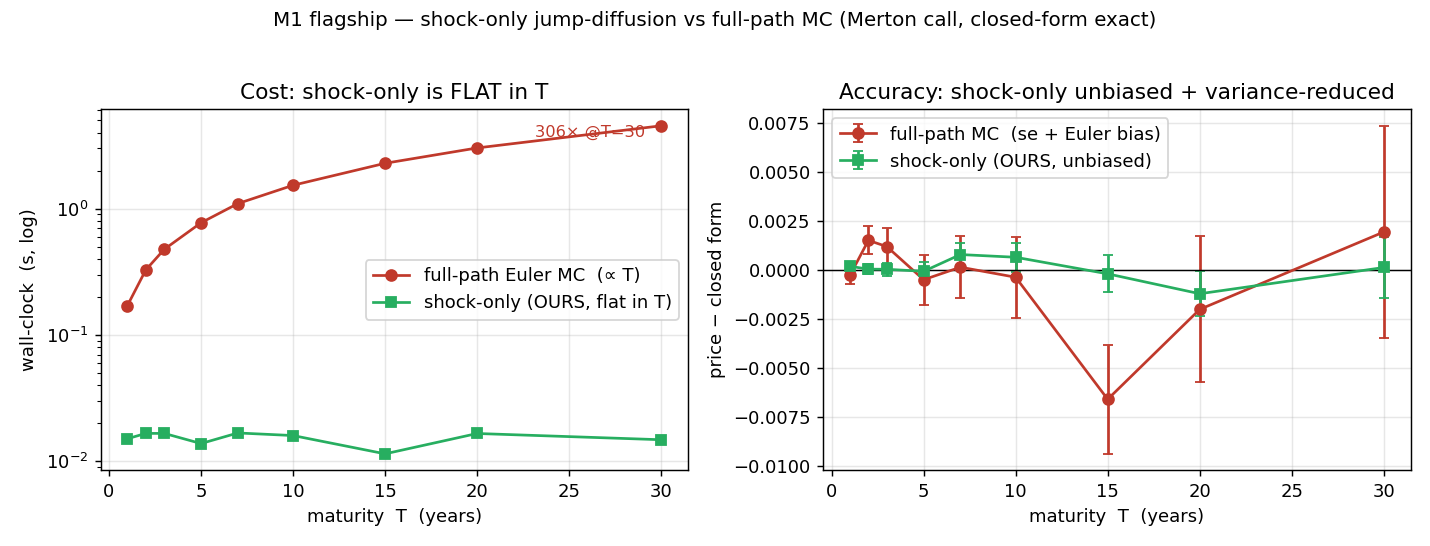
The solved operator is projected to a small subspace where any horizon is a small-matrix computation: applying thirty years costs the same as applying one day, and a whole maturity surface comes from one build.
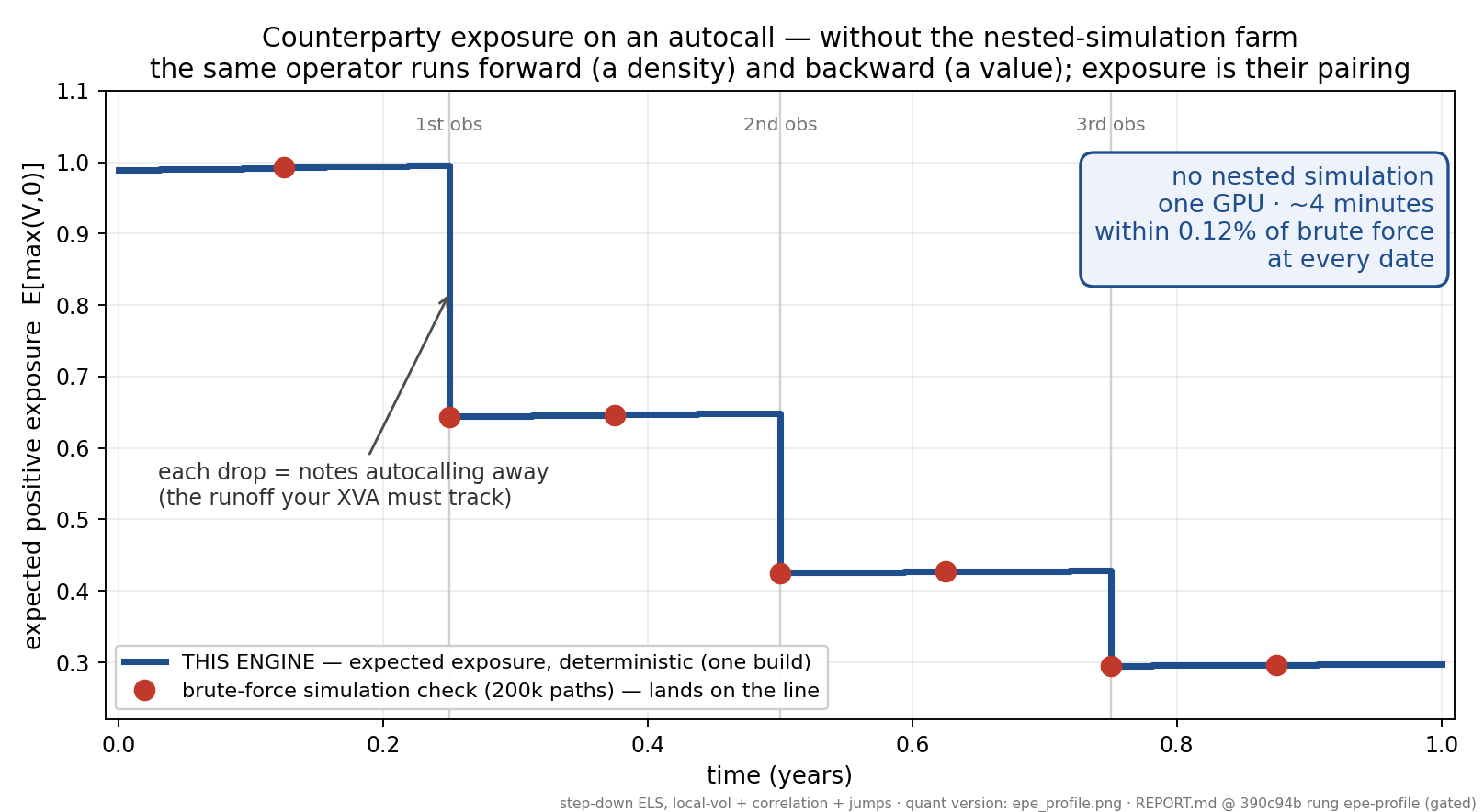
Autocall dates, memory coupons, and discrete knock-ins apply between marches as exact projections — discrete monitoring priced with no continuity correction. Run the same operator in reverse and it produces counterparty-exposure profiles with no nested simulation.
The number that matters most on the worst day — correlation risk through the knock-in — is the least reliable number on a simulation desk. It is a smooth, exact read here.
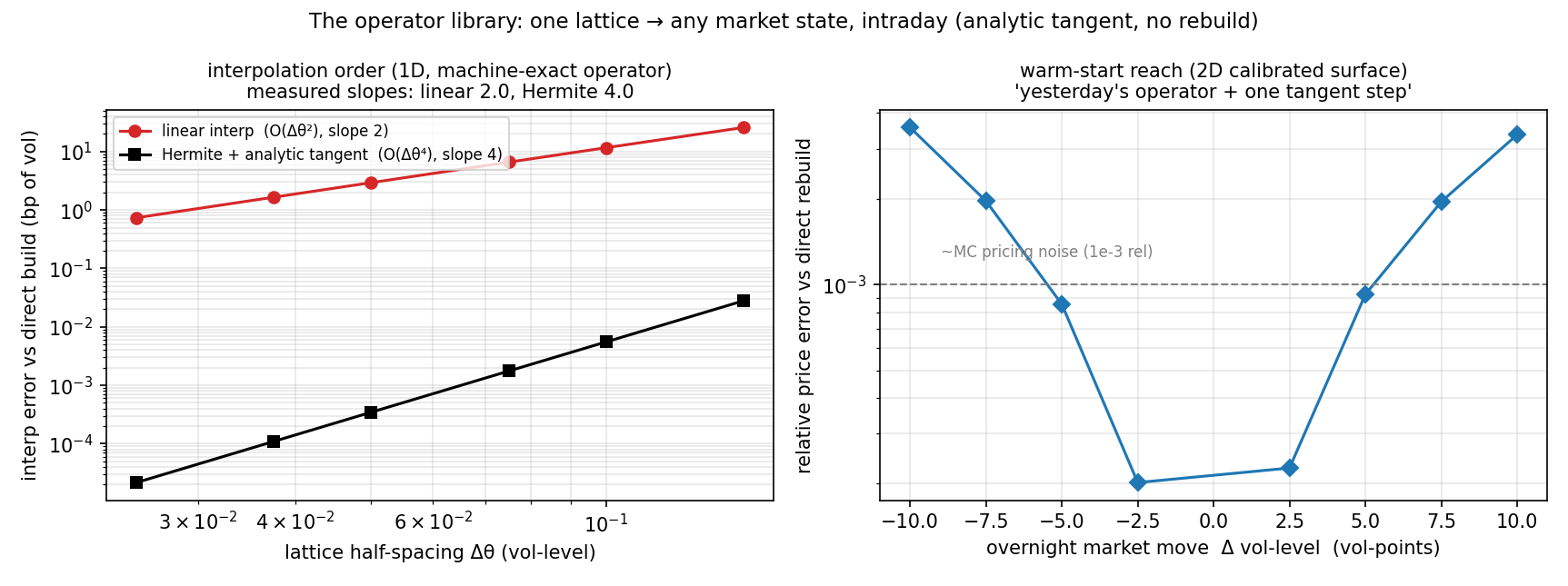
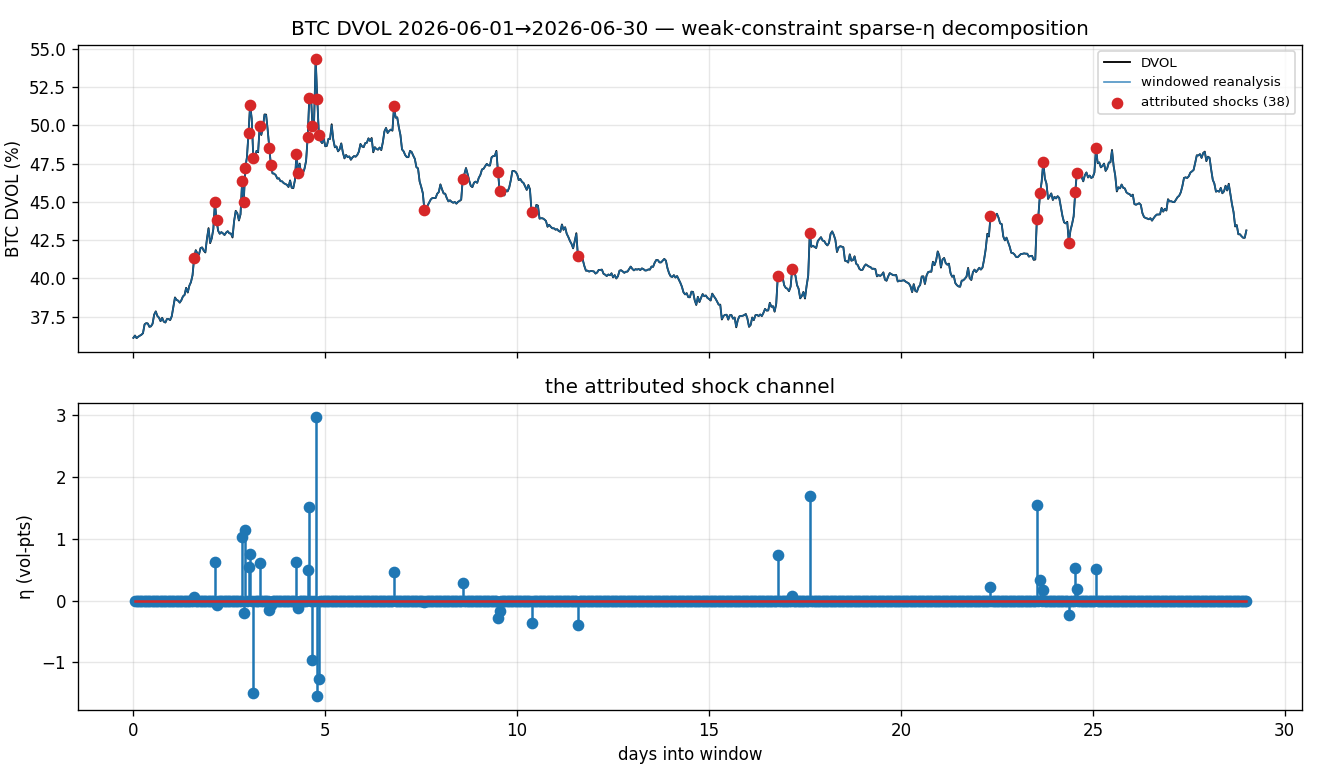
Because the value flow of the pricing model is a linear semigroup, streaming quotes can be assimilated into the model’s coefficients continuously, with calibrated uncertainty — and every innovation decomposed into noise, drift, or an attributed shock. Validated on live exchange options: exactly silent through quiet weeks, 38 named and sized events through a real volatility episode. Every commercial surface product either fits snapshots or reprices fast; none tracks a model-consistent trajectory, carries calibrated uncertainty, or attributes its misfit.
Claims about a pricing method should be cheap to check and expensive to fake. The comparisons run against closed forms, QuantLib, and converged Monte-Carlo — and the null results are published as prominently as the wins.
| Claim | Reference | Result |
|---|---|---|
| Real step-down term sheet (memory, discrete KI) | identical-logic Monte-Carlo | within MC noise (±0.02%) |
| Correlation risk through the breach | matched-seed MC bump | 4.76 vs 4.68 ± 0.17 |
| 2-asset worst-of | Stulz (1982) closed form | 10⁻⁸ |
| Whole implied-vol surface to 30y | Richardson-extrapolated fine CN | 0.006 bp mean · 1.6 s |
| Counterparty exposure profile | brute-force nested simulation | ≤ 0.12% at every date |
| Bermudan exercise | QuantLib finite differences | < 0.5% |
| vs Craig–Sneyd ADI / sparse CN, same grid | Stulz closed form | ~230× (price and corr. risk) |
Published nulls, for the avoidance of doubt: in 1D on raw payoffs, tridiagonal Crank–Nicolson wins wall-clock at equal accuracy; and simulation deltas are fine — we do not sell better deltas. The value is in the numbers simulation cannot read.
Fixed fee · week-two review · either side stops.